

For me, this was truly a huge deal and an honor of an interview to conduct.
I own a few Kaywoodies, Medicos, and my favorite, a Yello-Bole. Getting the chance to interview the man now at the helm of such a historic brand of pipes was incredible.
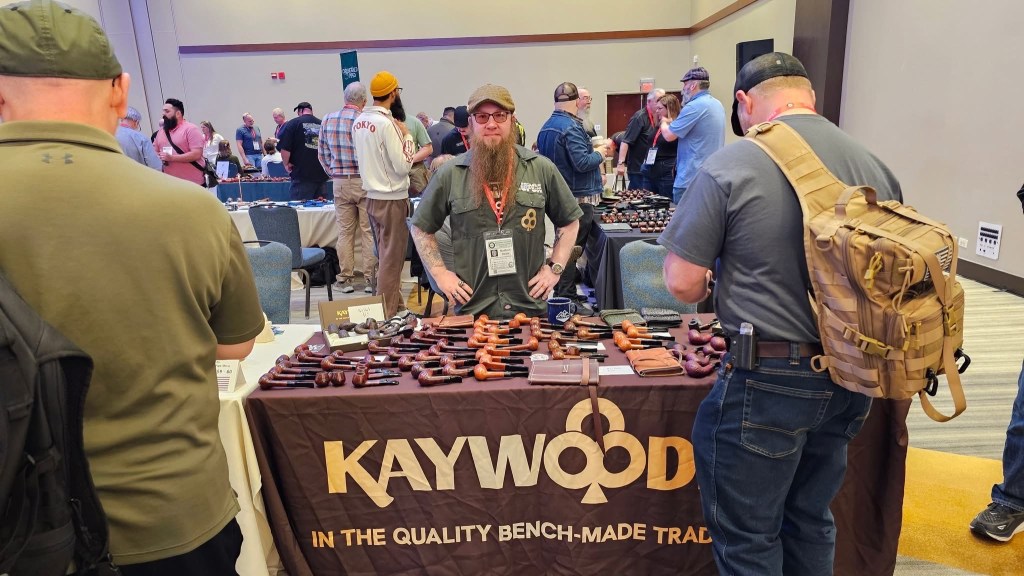
I had the pleasure of sitting down with Nathan, who is better known online as CrashtheGREY. He is the owner, pipe maker, and all-around heart behind Kaywoodie/Greywoodie Pipes. Nathan is also the host of the hit podcast, The Greywoodie Show.
Let’s get into it.
What Got You Started in Pipes?
“In college, we’d drink Scotch and watch Doctor Who,” Nathan laughed. “We just had a basket pipe from a headshop — nothing too fancy — and we’d smoke Irish Crème tobacco. It was terrible. That went on and off for years.”
He explained that later he was playing in a band. He did all the usual things in his 20s. He was smoking cigarettes. “One day, I realized it was awful. I had my old pipe laying around. I had some tobacco that somehow wasn’t dry. I thought — wow, this tastes a lot better. And I just picked up from there.”
His first Kaywoodie was a bent Super Grain from a flea market.
“At the time, I was working in law firms, and having a small pipe was handy. Later, I learned that pipe was from the 1930s.”
About six months after switching from cigarettes to pipes, he discovered that Kaywoodie still had Christmas parties.
“I ended up meeting Bill, the owner before me,” Nathan said. “In conversation, I mentioned the old ones were better than the new ones. Bill didn’t care much for that. Still, we became fast friends.”
For a few years, Nathan joked about quitting his job to sell Kaywoodies.
Having been a nanotech chemist, the pandemic left him stuck in pharmaceutical patents. One day, he grew tired of the day-in, day-out grind. He made the call. With his wife’s support, he gave up a six-figure career to sell Kaywoodie pipes.
Only six years later, he would end up owning the whole shebang.
“Is Bill Still Around?”
“Yes,” Nathan said. “Bill is still around. He’s the man who trained me. He showed me every which way to make a pipe.”
What Led to the Transfer of Ownership?
“Well, he got sick,” Nathan began. “He packed an order for me in his truck. He kept apologizing that he didn’t feel well. He also mentioned that there was a delay. I learned what happened when his son later found the package still in the truck.”
(To maintain Bill’s privacy, medical details have been omitted.)
“While Bill was recovering, I had been working behind the scenes. I needed to get everything in order. This included moving the warehouse, organizing the shop, and keeping shipments on time. It was a lot.”
Sadly, at 65, Bill had to retire. From his hospital room, he told Nathan that he’d have to take over the company sooner than expected.
Thanks to Nathan’s behind-the-scenes work, clients never saw a gap in service.
“I didn’t know if I could keep up with it all,” Nathan admitted. “Like someone who’s a fourth-generation maker with 30+ years of experience. Every single pipe is made by one person. I reshape them like Bill did, polish them like Bill did, and ship them like Bill did. It’s a lot. It’s time-consuming — and I can’t help but love it!”

On Old Timers and the Pipe Community
As we spoke, we began to talk about the “old timers.” We discussed the fading traditions of pipe smoking. Both of us miss these traditions.
“You’d be surprised,” Nathan said. “We have this regular. He’d email Bill with a simple message: ‘I need a pipe.’ So Bill would collect payment, mail him a pipe that he’d smoke after dinner in his chair. A year later, the bowl couldn’t even fit a cigarette. He’d toss it in the fireplace and send the same message again — ‘I need a pipe.”
Nathan paused, then continued. “So, there’s still some of that original pipe-smoking culture out there.”
What Pipes Do You Hate Making?
“I don’t really make pipes I hate,” he said. “However, I hate making Campus pipes. It has nothing to do with the look or the stinger.”
He explained that they had thousands of stems with the stinger built in.
“They’re tiny, super thin material, and a pain to work on. I hate them because they’re a nightmare to make. And a nightmare for the user to upkeep. One in every ten you break just stamping it. It gets frustrating.”
Bill’s Last Handmade Pipe
“I told Bill he could keep doing the handmades if he wanted to,” Nathan recalled. “It was a carrot dangled in hopes he’d continue.”
A few months later, Bill called him.
He’d woken up. He looked at his workbench. He sipped his coffee and lounged in his chair. Then he said, “‘I realized… it’s not my problem anymore. I can just relax. The company’s in great hands.’”
While cleaning the shop, Nathan found a boxed pipe — Bill’s last handmade.
“Oh, that thing?” Bill said when asked. “Yeah, the mouthpiece doesn’t fit quite right. You can feel it oddly in your mouth, so I set it down. Wasn’t satisfied with it.”
Nathan smiled. “I can’t even tell what he was talking about. But the fact he remembered exactly why it was a reject shows how much he knew his pipes. It also shows how much care he put into each one. That’s what I try my best to do.”
I suggested maybe framing it as a museum piece.
“You know,” he said, “that’s a good idea… I may do that.”
Where Is the Pipe Hobby Headed?
“It’s never gonna be like the old timers,” Nathan said plainly. “It’ll die one day — but not in our lifetime. There’s a resurgence. Younger people are seeing the mental benefits. I think we’ll have a small boom.”
Why Kaywoodie Still Matters
What makes Kaywoodie such a special brand — and this interview so meaningful — is the way Nathan works.
He makes most of the pipes on the same vintage equipment used to craft Kaywoodies, Medicos, and Yello-Boles decades ago. Machines that made pipes your grandfather might have smoked.
Tools that still bear the S.M. Frank nameplate.
“One’s even just a really old Dremel clamped to a board,” he said with a grin. “And yet, that’s how they did it for so long. They made some of the best, most affordable pipes anyone could own.”
There’s so much more that we touched on in our conversation — enough for another article entirely. I plan to write a deep dive on the history of Kaywoodie soon. For now, I’m grateful to share Nathan’s story.
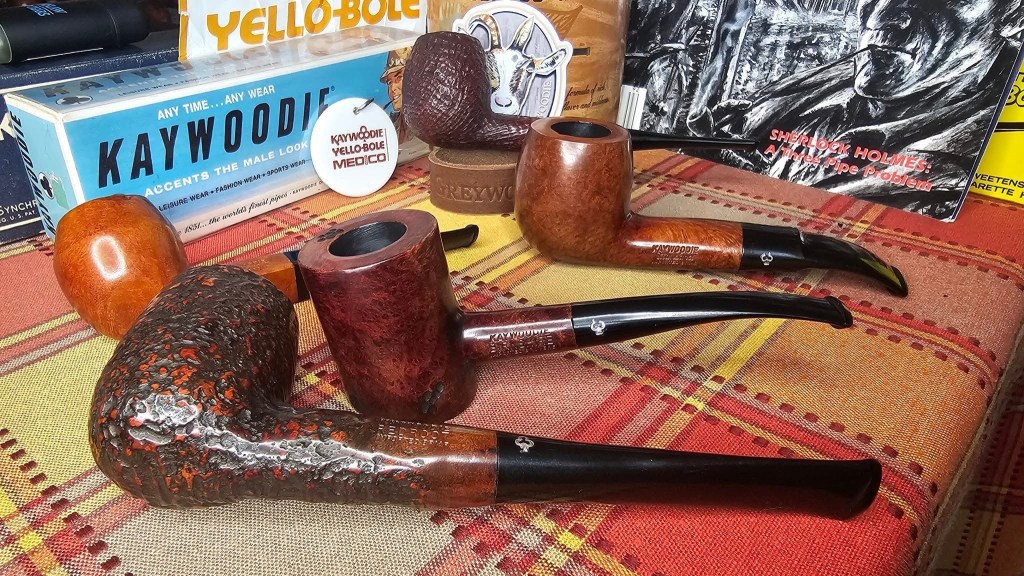

Image Credits:
All images are Nathan’s. The one of him at the merchant’s table was taken at the Chicago Pipe Show.
All photos are used with the kind permission of Nathan’s official Greywoodie Facebook page.
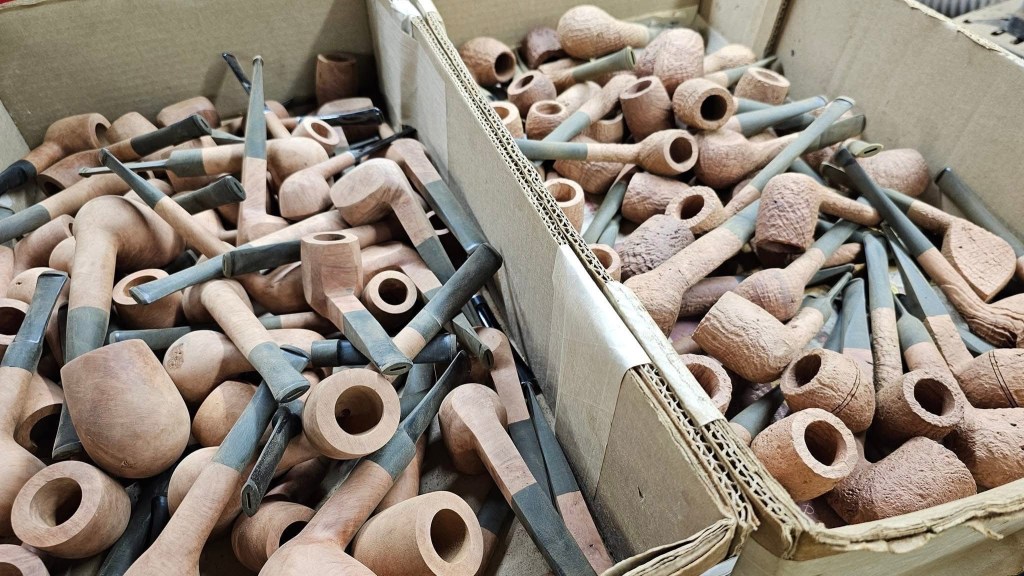
The lighter-colored pipes shown are before being polished and finished.
Links:
Website: https://greywoodie.com
Podcast: The Greywoodie Show
 Quack Pack Tabac