
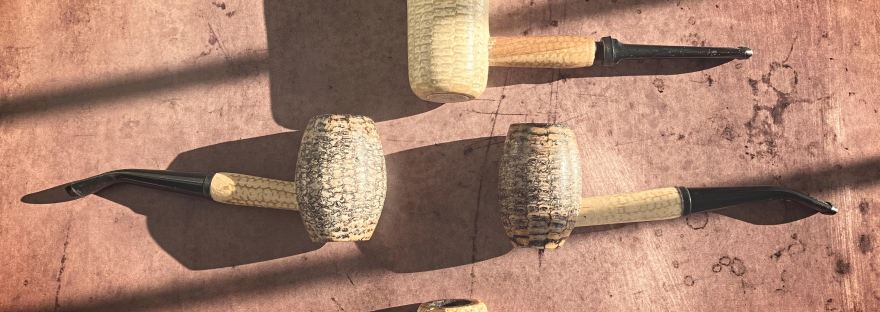
For many people, their very first pipe — mine included — was a corn cob pipe. And nine times out of ten, it was a Missouri Meerschaum.
It’s classic. It’s American history. It’s affordable and practical.
Fictional characters like Popeye and Frosty the Snowman have made it iconic.
What exactly is a corn cob pipe?
A corn cob pipe, as the name suggests, is a tobacco pipe. It is made from the dried and milled cob of an ear of corn. Traditionally, the stem is made of bamboo, though some modern versions use acrylic for a fancier touch.
Why is it a beginner’s favorite?
Simple, it’s affordable and easy to smoke.
I received my first corn cob pipe as a gift from my grandpa: The Country Gentleman by Missouri Meerschaum. It’s easy to keep and provides a dry, cool smoke thanks to the cob’s porous nature.
This simple pipe has been a constant companion to everyone from farmers to writers. Its humble shape carries a rich, smoky history.
A little history:
The earliest reference I found came from Sir Arthur Conan Doyle’s The Refugees, published in 1803. There’s only one brief mention across 393 pages, but it shows how long the cob pipe has been around.
Farmers often made their own pipes from whatever was on hand — and corn, of course, was plentiful. When life gives you corn, make a pipe!
Another early mention appeared in The Phenix Gazette of Alexandria, D.C., dated March 30, 1830. It referenced a Mr. Benham of Ohio and stated that President Andrew Jackson “had a preference for the yellow leaf.” President Jackson thought it “most pleasant when smoked in a corn cob pipe.”
Even Jackson’s wife, Rachel, reportedly smoked a corn cob pipe on the advice of her doctors. This was a supposed remedy for shortness of breath (ironic, indeed). Other records mention Jackson enjoying his pipe at his Tennessee plantation, The Hermitage, just days before taking office.
Missouri Meerschaum: The Birth of a Legend
Fast forward to 1869, just four years after the Civil War ended. A small company in Washington, Missouri began making corn cob pipes commercially.
That company was founded by a Dutch immigrant and woodworker named Henry Tibbe. One day, a farmer named John Schaenke brought Tibbe a bag of discarded cobs. He asked Tibbe to “turn” a pipe on his lathe.
Maybe the farmer’s hands were too sore to whittle his own. Or he just wanted a smoother, more comfortable pipe. Either way, Tibbe accepted the challenge, and his creation sold quickly in his shop. Soon, he was making more pipes than woodwork and thus, the corn cob pipe industry was born.
By 1878, Tibbe and a chemist friend developed a plaster-like coating to strengthen and fireproof the pipes. In 1883, Tibbe and his son Anton patented the process.
The name “Missouri Meerschaum” was officially coined in 1907. By 1925, a dozen other companies were making corn cob pipes but only Missouri Meerschaum has endured.
Today, the company still produces over 2,000 pipes a day. It grows around 150 acres of corn. The company also contracts with other farms as needed. Each cob is inspected. Then, it is dried for two years. After that, it is plastered, milled, and finished. This process is the same as it was more than a century ago.
Famous corn cob smokers:
Corn cob pipes have been smoked by everyone from farmers and riverboat gamblers to bayou banjo players. Here are a few famous names who shared in the tradition:
General Douglas MacArthur
MacArthur’s signature pipe — custom made by Missouri Meerschaum — featured a long shank for a cooler smoke. It had a shortened tobacco chamber and an extended bowl. He even used it as a pointer during briefings.
He would burn a ring on each new pipe to mark it as his own. Today, his design is immortalized as the MacArthur 5-Star Corn Cob Pipe.
Writer Christopher Morley
Morley was an avid pipe smoker and a prolific author. He penned The Haunted Bookshop. This book inspired a pipe tobacco blend of the same name. One of its chapters, The Corn Cob Club, celebrates the simple joy of a humble cob.
He also wrote an essay titled A Message for Boonsville, which began:
“When corncob pipes went up from a nickel to six cents, smoking traditions tottered… It was the supreme test of our determination to win the war: the price of Missouri meerschaums went up 20 percent and there was no insurrection.”
“Yesterday we went out to buy our annual corncob, and were agreeably surprised to learn that the price is still six cents… A corncob is sadly hot and raw until it is well sooted, but the ultimate flavor is worth persecution.”
Mark Twain
Twain was famously fond of his corn cob pipe and so were his characters. Both Tom Sawyer and Huckleberry Finn were depicted smoking them.
CIA Director Allen Dulles
Even the head of the CIA was a fan. In 1960, Missouri Meerschaum sent Dulles a letter thanking him for his appreciation of their pipes. The letter wasn’t declassified until 2003 and can be found in the CIA archives today.
Should you try one?
Absolutely.
A corn cob pipe requires no break-in period, delivers a dry, cool smoke, and rarely gurgles. It’s affordable, practical, and timeless. You can pick one up directly from Missouri Meerschaum’s website for as little as $5–$10. Alternatively, you can splurge on one of their more ornate models. These are still far cheaper than most briar pipes.
Personally, I like to enjoy mine while walking along the creek banks or during a few friendly hands of poker. There’s nothing quite like that showboating southern gentleman feeling. You have a cob in your teeth, a winning hand, and a sly grin as you rake in the pot.
 Quack Pack Tabac